On April 24, 2026, three things happened in the same week that should change how every small business owner thinks about AI.
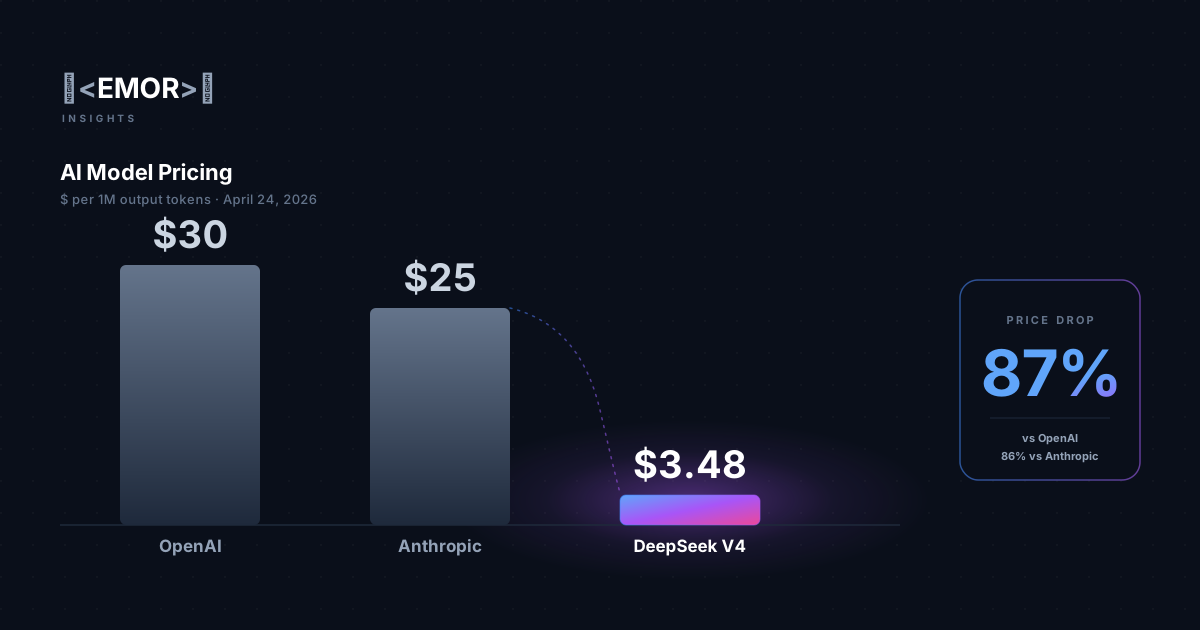
DeepSeek released V4, its biggest model ever, at $3.48 per million output tokens. OpenAI and Anthropic charge $30 and $25 for the same volume. OpenClaw — one of the most popular AI agent platforms in the world — switched its default model to DeepSeek V4 Flash. And Huawei announced that V4 was trained entirely on its Ascend 950 chips, with no Nvidia silicon involved.
If you're running a service business, a clinic, an agency, or any company that's been priced out of "real" AI, the practical impact of those three announcements is bigger than any single product launch in the last two years.
What Actually Happened
Let's break the story into the three pieces, because the headlines smashed them together.
DeepSeek V4 — A Chinese AI lab released two new models. V4 Pro has 1.6 trillion parameters. V4 Flash has 284 billion parameters with 13 billion activated per token, and it performs close to V4 Pro in most benchmarks. Both handle a 1 million token context window — large enough to fit all three Lord of the Rings volumes plus The Hobbit in a single prompt. The pricing: $3.48 per million output tokens for V4 Pro.
OpenClaw — One of the most-used AI agent platforms made V4 Flash its default model and added V4 Pro as a premium option. DeepSeek explicitly optimized V4 for OpenClaw's agent framework, alongside Claude Code and CodeBuddy.
Huawei — DeepSeek trained V4 entirely on Huawei Ascend 950PR and 950DT chips, plus Cambricon accelerators. Huawei's AI software stack (CANN, their alternative to Nvidia's CUDA) had day-zero support for V4. No Nvidia GPUs were used.
The headline writers compressed this into "Chinese AI partnership shakes up market." That misses the real story.
The Real Story Is the Price Collapse
Let's do the math that matters for your business.
If you've ever priced out a custom AI feature — a chatbot, a document analyzer, an automated email responder — the bill usually looked like this:
- OpenAI GPT-4 class: $30 per million output tokens
- Anthropic Claude Opus: $25 per million output tokens
- Self-hosted open models: Cheaper per token, but expensive to run reliably
For a small business processing 5 million tokens a month (a moderate chatbot or content tool), that's $125-$150/month in just model costs. For a heavy use case — an AI that handles every customer service ticket — you might be at 50 million tokens/month, or $1,250-$1,500/month.
At $3.48 per million tokens, those bills become $17 and $174.
That's not a discount. That's a category change. Things that didn't pencil out at GPT-4 prices — like running AI on every email, every form submission, every voicemail transcript — start penciling out hard.
Why Three Companies Pulled This Off
This isn't pure price cutting. It's an architectural shift.
DeepSeek's V4 uses a Mixture-of-Experts design — only 13 billion of V4 Flash's 284 billion parameters fire on any given token. That's why it can match much bigger models while costing a fraction to run.
Huawei's chips mean DeepSeek isn't paying Nvidia's margin. Every other major AI lab buys H100s and H200s at premium prices. DeepSeek used Ascend 950s — Chinese-made, sold inside China at much lower margins. Lower training cost flows through to lower inference cost.
OpenClaw's adoption matters because distribution is everything in AI. A great cheap model that nobody can call easily doesn't move the market. OpenClaw making V4 Flash the default puts it in front of millions of developers and businesses overnight.
Three companies, each solving one piece of the cost puzzle. The result is the largest single-step price drop the AI market has seen.
What This Means If You Run a Small Business
The naive read is "great, I'll switch to DeepSeek and save money." That misses the point. Most small businesses aren't using AI at all yet — switching providers isn't the question. The question is whether the economics finally work for the project you've been postponing.
Here's how to think about it:
1. Things that didn't pencil out before are about to.
If you got a quote 6 months ago to build an AI feature and the model costs killed the budget, ask for a refresh. The same feature might cost 80-90% less to run now. Examples we see kicked off internal projects this week:
- AI receptionist transcription + summarization for every call → previously $40-$60 per 1,000 calls in model costs, now $5-$8
- Document classification for inbound emails/forms → previously $200-$400/month, now $25-$50
- Lead qualification scoring with reasoning + memory → previously expensive enough that businesses just used regex, now genuinely cheap
2. Don't lock yourself into one vendor.
The price collapse just proved how fast the AI vendor landscape can shift. A year ago OpenAI was the default. Six months ago Anthropic was hot. This week DeepSeek is undercutting both by 9x. Whoever you build with, build for swappability — your prompts, your data, your workflows should not be welded to one provider's API.
This is the single biggest mistake we see businesses make: signing 12-month contracts for "AI suites" that lock the model in. Your model layer should be the easiest thing to swap.
3. The geopolitics aren't your problem — until they are.
Huawei's involvement means V4 ships under different export controls than US-made AI. For most small businesses, that's irrelevant. For regulated industries (healthcare, finance, defense contractors, anyone with government clients) it might matter a lot. If you're in that bucket, ask the question explicitly: where is your model hosted, who built it, and does that affect your compliance posture?
For everyone else, the answer is "use the cheapest model that produces the quality you need" — and right now that calculus shifted.
The Partnership Lesson, For Real
The original story was framed as "AI partnerships matter." That's true but trivially so. The actually useful lesson is what kind of partnership matters.
DeepSeek didn't partner with OpenClaw and Huawei to share marketing. They partnered to combine a model, a distribution channel, and an infrastructure stack — three different competencies, none of which any single company could have built fast enough on its own.
The lesson for your business is the same. When you're choosing technology partners, the ones who matter aren't the ones with the best logo or the loudest sales team. They're the ones who give you capabilities you can't build yourself in a timeframe that matters. Cheap LLM access, hosting, agent frameworks, integrations — pick partners who own one piece of the stack deeply, not generalists who own none of it well.
This is also why we build the way we do at EMOR: we don't try to own every layer. We own the layer that makes AI usable for businesses — voice, scheduling, lead intake, ownership of your data — and we plug into the best model the market offers, this week or next week.
What to Actually Do This Quarter
Three concrete moves:
- Re-quote any AI project you shelved. If the math killed it before, run it again with V4-class pricing. Many shelved projects are now viable.
- Audit your existing AI vendors for swappability. Can you change models without rewriting your app? If not, that's a wedge your competitor will use against you.
- Pick one workflow you're losing money on and put AI on it. With model costs at $3-5 per million tokens, the bar for "is it worth automating" just dropped dramatically. Inbound calls, missed leads, manual data entry — pick one and run a 30-day test.
The Window
The April 24 announcements aren't a one-time event. They're a signal that AI pricing is going to keep dropping fast as competition intensifies and Chinese labs find new ways to do more with less hardware.
Businesses that adopt now will spend a fraction of what their competitors will pay if they wait until 2027 to "see how it shakes out." Not because they get an early-mover discount on infrastructure — that's actually inverted, since prices keep falling. Because they spend the next year learning how to use AI in their workflows, while their competitors spend that year still talking about whether to.
The technology gap that opens up isn't measured in dollars. It's measured in operational competence. And by the time the businesses on the sidelines decide to move, the early adopters will be three product cycles ahead of them.
That's the partnership lesson worth taking seriously.