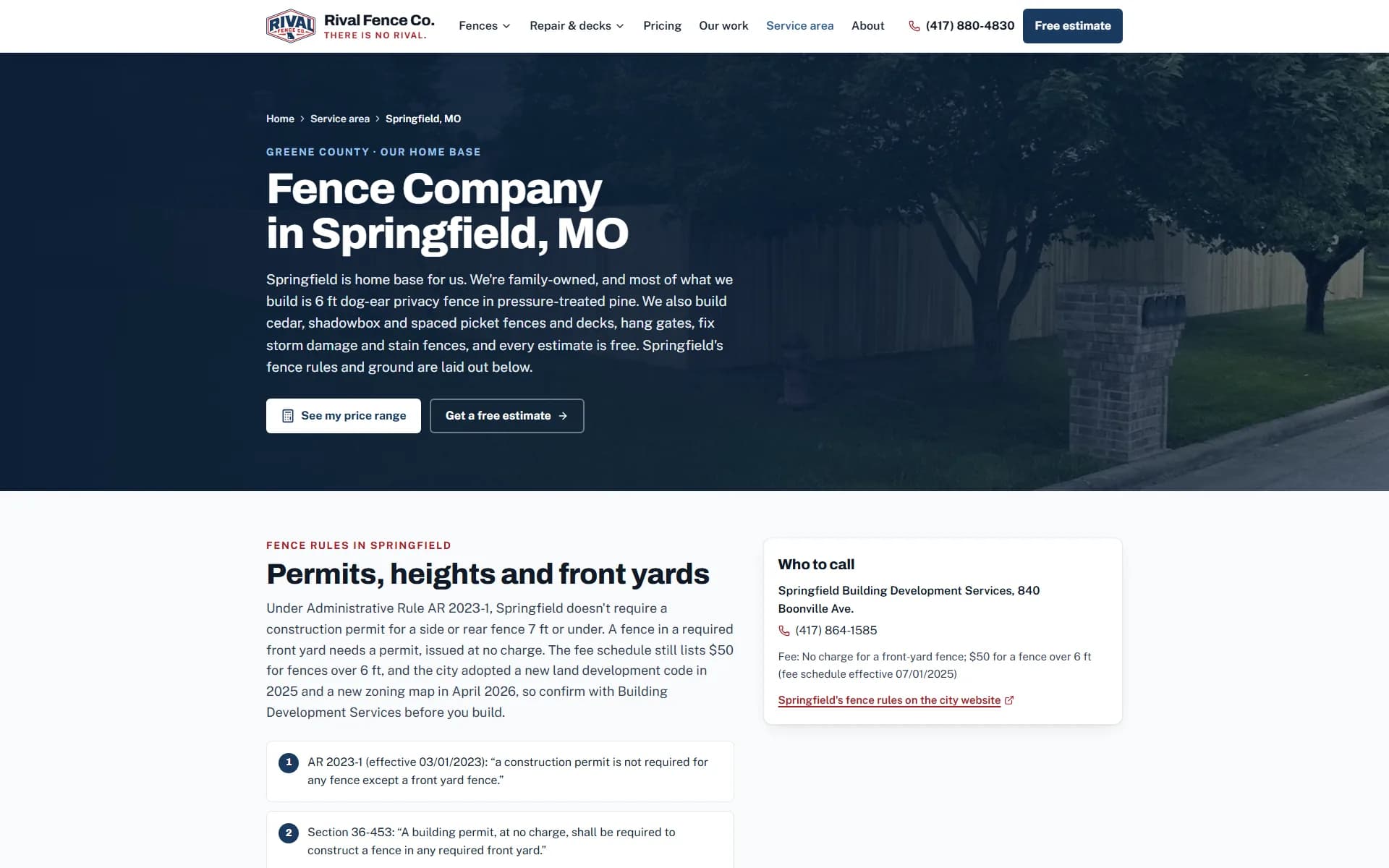
A fence company based in Springfield, Missouri builds in Nixa, Ozark, Republic and Willard every week. A painter based in Madison, Wisconsin works all of Dane County. Homeowners in those towns put the town in the search, and a contractor who wants that work needs a page that answers it. The question owners ask us is whether a page for every town is still safe to build after a year of Google updates aimed at exactly that kind of page. It is, as long as each page is about the town. The pages that got hurt are the ones where the only thing that changes is the name.
This guide covers what Google's policies actually say, the one test we put every town page through, two sets of town pages our team built in October 2026, what goes on a page that passes, when to skip a town, and what to do with a site that already has forty copies.
What Google's policies say, in Google's words
Two of Google's spam policies cover town pages. Both are short and both are worth reading at the source.
The first is doorway abuse. Google defines it as pages "created to rank for specific, similar search queries" that "lead users to intermediate pages that aren't as useful as the final destination". Two of the four examples it gives describe a bad town-page section exactly: "having multiple domain names or pages targeted at specific regions or cities that funnel users to one page" and "creating substantially similar pages that are closer to search results than a clearly defined, browseable hierarchy".
The second is scaled content abuse, which Google describes as "when many pages are generated for the primary purpose of manipulating search rankings and not helping users", and which applies "no matter how it's created". The examples include "using generative AI tools or other similar tools to generate many pages without adding value for users" and "creating many pages where the content makes little or no sense to a reader but contains search keywords". The policy ends with a plain instruction: if you host content like that, exclude it from Search.
Google's guide to creating helpful, reliable, people-first content adds a self-check, and three of its questions are the town-page questions: "Is the content primarily made to attract visits from search engines?", "Are you using extensive automation to produce content on many topics?" and "Does your content leave readers feeling like they need to search again to get better information from other sources?"
Put those together and the rule is plain. Forty pages that read "licensed plumber in [town]" with the town swapped send everyone to the same phone number, tell a reader nothing the next town's page does not, and exist to rank. That is the pattern the policies describe. A page that tells a Nixa homeowner what Nixa requires before a fence goes up is a different thing, and Google has no quarrel with it.
The one test a town page has to pass
Before our team writes a town page we ask one question: what would a homeowner in this town learn here that the page for the next town over cannot tell them?
If the honest answer is nothing, we do not build the page. If the answer is a permit rule, a fee, the age of the houses, what is under the sod, a drive time or a job we did two streets over, the page has a reason to exist, and a reader and a search engine can both see it.
Two sets of town pages, built in October 2026
Rival Fence Co. is a family-owned fence and deck company in Springfield, Missouri. Its new 36-page site, which our team built and launched in October 2026, has twelve town pages, and each one lays out that town's fence rules. The Springfield page states the city's rule in the city's terms: under Administrative Rule AR 2023-1, a side or rear fence of seven feet or under needs no construction permit, a fence in a required front yard needs a permit issued at no charge, and the fee schedule lists a charge for fences over six feet. It notes that the city adopted a new land development code in 2025 and a new zoning map in April 2026, tells the reader to confirm with Building Development Services, gives that office's address and phone number, and links to the city's own page. Change the town name on that page and the rule, the fee and the phone number would all be wrong. That is what a real town page looks like.
The same site's pricing page names the three things that change a fence price most around Springfield: rock under the sod, slope, and tearing out an old fence. Ground conditions belong on a town page for the same reason the permit rule does. They are true of that place and they change the job.
Olmos Painting is a family-owned painting contractor in Madison, Wisconsin. Its new site, launched the same month, has 14 town pages written around each town's housing stock, in English and in Spanish. The Madison page opens on the year that organizes a painting job there. By the page's account, roughly half of the city's housing predates 1978, which makes lead-safe certified work a legal requirement on those houses. It then splits the city into three kinds of house, pre-1930 wood and plaster on the near east and near west sides, 1950s and 60s ranches through Midvale Heights and Westmorland, and post-1995 engineered siding on the far west and far east, and says each fails differently and needs different prep. A homeowner in a 1962 ranch reads that and knows the painter has stood in a living room like theirs. A fact box beside it gives the drive time, the population and whether there is a travel charge.
Neither set of pages was written by swapping a name into a template. Each one took research into the town, and that research is what the page is made of.
What goes on a town page
- The rules that apply there. Permits, fees, heights, setbacks, what the HOAs in that town tend to require, the office to call, and a link to the source. Rules change, so date them and plan to check them.
- The houses and the ground. Housing age, siding and plaster, soil and rock, slope, lot sizes. Whatever changes your prep and your price in that town belongs on the page, because it is also what the homeowner is wondering about.
- Your work there. Jobs you have done in that town, with photos labeled by town, and the streets and subdivisions you know.
- Drive time and travel charge, stated plainly. "Same day" and "none" are facts a homeowner wants.
- The questions people in that town ask you. Every crew hears a different question in each town. Write the answers down.
- A ballpark where your trade allows it, and the way to start: an estimator, a planner or a callback request, the same ones the rest of the site uses.
- A place in a real hierarchy. A service-area hub with a map and a ZIP code check that links to every town page, and every town page linking back. Google's doorway examples single out pages "closer to search results than a clearly defined, browseable hierarchy". The hub is the hierarchy.
When to skip a town
Skip the page when you have nothing true to say about the town. Skip it when you do not want the work there, because an hour's drive each way turns a good job into a thin one. Skip it when the town is too small for anyone to search it, and fold it into the page for the town next door. A town page you cannot fill makes the good ones look worse, because it tells Google the whole section might be thin. Both of the builds above stopped where the facts stopped. Rival Fence's service-area map names 22 towns and twelve of them have a page; the other ten are on the map and in the ZIP code check, and that is enough. Olmos lists 54 communities it serves across Dane County and gives 14 of them a page.
If your site already has forty copies
Start in Search Console. Export the town pages with their impressions and clicks over the last year. Most of them will have close to none, which makes the decision easy.
Keep the towns you can write a real page for, and rewrite them one at a time with the list above. Point the rest at your service-area hub with a one-hop redirect so any links to them still land somewhere useful, or exclude them from Search, which is the step Google's own policy page recommends for scaled content. Then resubmit the sitemap. Fewer, fuller pages will carry more of your towns than forty copies ever did.
The Google Business Profile side
A town page gets you into the regular results for that town. The map results come from your Google Business Profile, and for a contractor who drives to the customer, the profile should be set up as a service-area business with the towns you actually serve, and the name, phone number and services on it should match the website exactly. Photos of finished jobs with the town named do double duty: they fill the profile and they give the town page something to show. How the two rank together is on our SEO and GEO page.
What to measure
Check three things a quarter: impressions and clicks per town page in Search Console, the search queries that include a town name and which pages they land on, and the town or ZIP code on the requests that come in through your estimator or planner. A town page that gets impressions and no requests needs a better way to start. A town that sends requests with no page yet is the next page to write.
Where we come in
Town pages are part of every site our team builds for a trade business, and part of the marketing package we keep working on after launch: the SEO, the GEO and AEO that get you named by AI assistants, and your Google Business Profile. See how it fits together on our SEO and GEO page. We build the systems your business runs on. Then we run them with you.
If you run a crew of one to five and want every town you drive to working for you, answer four quick questions below and we'll tell you straight whether we're a fit.