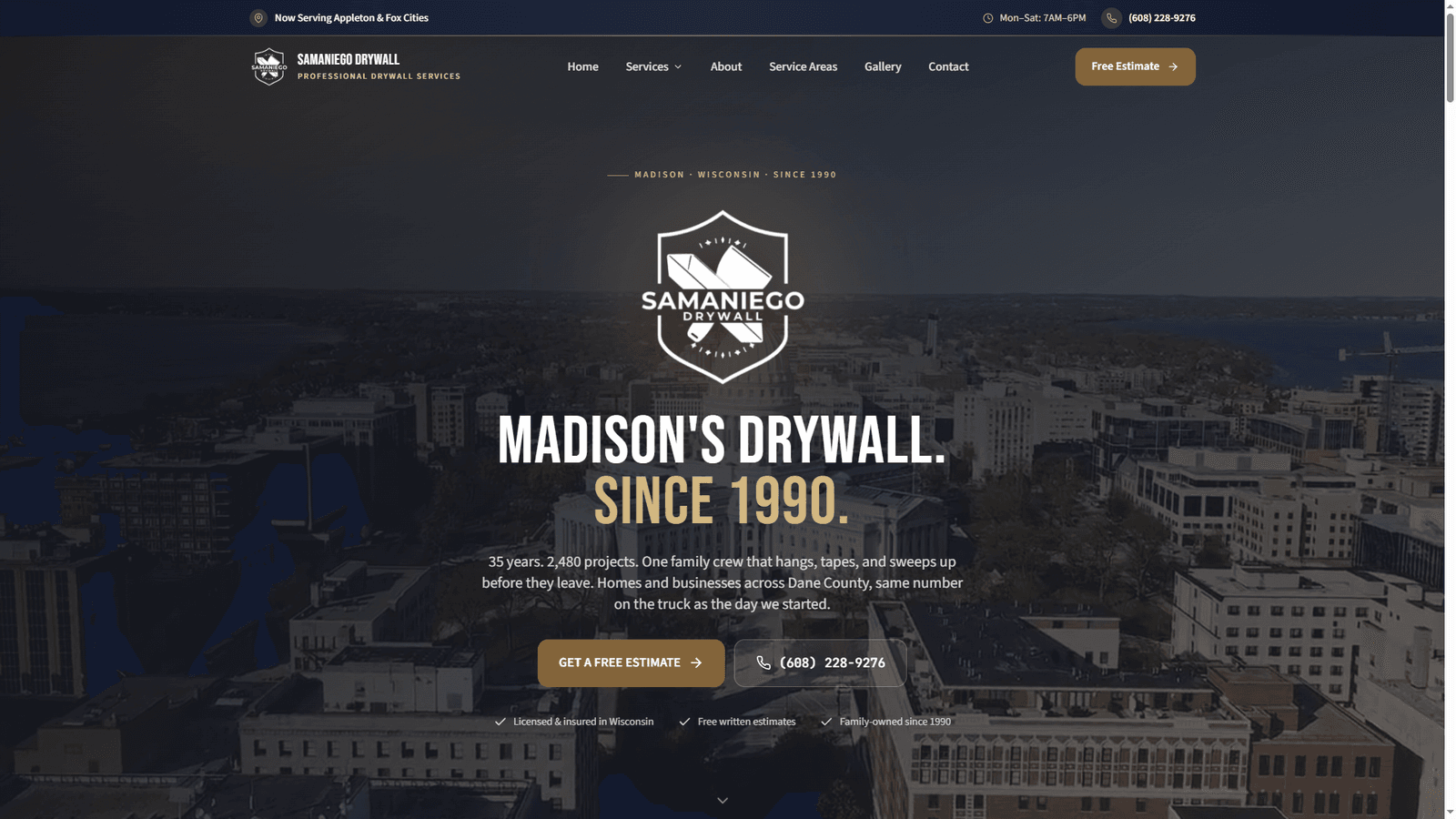
Samaniego Drywall is a family crew in Dane County, Wisconsin, around Madison. They have been hanging and finishing drywall since 1990. When they came to us, they had no website and no systems. Every job lived in a paper binder.
In 90 days, we built them a website and a project estimate tool. Leads now arrive scoped and priced, follow-up goes out by email and text, and over $50,000 in estimated project value has moved through the tool.
This drywall contractor website case study covers what we built, how each piece works, and what a crew of one to five can take from it.
Where they started
When Samaniego Drywall came to us, the crew had decades of work behind it and no website in front of it.
- No website. A homeowner searching for drywall help around Madison had no site of theirs to land on.
- No systems. Every job lived in a paper binder.
Plenty of solid crews run exactly this way: the reputation lives with past customers and the people who send them work. A binder is a fine record of work already won. The job of the build was to bring in the next job, from people who had not met the crew yet.
What we built in 90 days
Four pieces, each one feeding the next.
A Madison-focused contractor website
Built around the work the crew does, with a drywall installation gallery and a before-and-after showcase, so a homeowner can see finished rooms before they ever call. SEO and lead capture were part of the build from the start.
A multi-step project estimate tool
The center of the build. The homeowner works through three steps: rooms first, then details (square footage, finish level and timeline), then contact. The tool returns a real number, and the crew gets a lead that already describes the job.
Lead capture wired to the tool
Every estimate becomes a lead that lands with the crew, scoped: which rooms, how big, what finish, and roughly what the job is worth. It reads like a work order instead of a phone message.
Follow-up by email and text
When a request comes in, follow-up goes out by email and text, so the homeowner hears back while they're still thinking about the job, and nobody on the crew has to stop work to send it.
The build at a glance
| Piece | What it does |
|---|---|
| Madison-focused website | Gives homeowners a place to find the crew and see the work |
| Installation gallery and before-and-after showcase | Shows finished rooms before anyone picks up the phone |
| Multi-step project estimate tool | Rooms, square footage, finish level and timeline in, a real number out |
| Lead capture | Each estimate lands with the crew, scoped and priced |
| Follow-up by email and text | The homeowner hears back while they're still deciding |
How a job moves through it now
Put the pieces together and a new job follows the same path every time:
- A homeowner finds the site and sees finished rooms in the gallery and the before-and-after showcase.
- They open the estimate tool and pick the rooms that need drywall.
- The tool takes them through square footage, finish level, timeline and contact details, and returns a real number.
- The lead lands with the crew, scoped and priced.
- Follow-up goes out by email and text.
- The crew calls back the jobs worth a walkthrough, with the scope already in hand.
Everything up to that last call happens while the crew keeps working.
What changed
- Over $50,000 in estimated project value has moved through the tool. That is the value of the estimates homeowners built for their own jobs.
- Leads arrive scoped and priced. The crew sees the rooms, square footage, finish level and a number before anyone makes a call.
- Follow-up goes out by email and text on its own, so the first touch happens while the crew keeps working.
Pilar Samaniego wrote this in a Google review:
EMOR AI did an excellent job helping my drywall business get online. They built a professional website, were easy to work with, and answered every question I had along the way. Since launching the site, I've started getting jobs from people finding me online. Very happy with the results, highly recommend.
Why the estimate tool matters most
A website on its own gives a homeowner somewhere to land. The estimate tool gives them a reason to reach out, and it gives the crew something to work with when they do.
Picture two messages waiting at the end of a long day. One says "need a quote on some drywall, call me." The other lists a basement with three rooms, the square footage, Level 4 for flat paint, a start date next month, and an estimate. The second one tells you what to bring to the walkthrough before you ever dial.
A homeowner who spends a few minutes picking rooms and a finish level is serious about the job. A lead that arrives with square footage and a number lets a small crew decide which walkthroughs are worth the drive and which jobs fit the schedule. For an owner-run crew, that's the lever: better jobs, chosen on purpose, instead of a longer list of calls to return.
It changes the first phone call too. The call opens with the job already on the screen, so the conversation can go straight to what the homeowner wants the finished room to look like and when the walkthrough happens.
One note on the number
We keep case studies to what we can show. The $50,000 is estimated project value that has moved through the tool: the estimates homeowners built for their own jobs. It is not a count of signed contracts, and we don't present it as one. It is the clearest measure of the demand the site now captures, and every one of those estimates arrived scoped and priced.
What a crew of one to five can take from this
- A real system fits a small crew. A family crew went from a paper binder to a working site and estimate tool in 90 days.
- Lead with a number. A homeowner who gets a real estimate on your site reaches out with the job already described. Here is how to put an estimate tool on your drywall website.
- Show the finish. A gallery and before and after shots do the selling you'd otherwise do in the driveway. More in what a drywall contractor website needs.
- Let follow-up run on its own. Email and text go out while you're on the wall, and you call back the jobs you want.
- Keep the proof current. Every finished room is a new photo for the gallery and a reason for the next homeowner to trust you.
- Get found on Maps too. Your Google Business Profile sends homeowners to the site where they get their number.
- Build your own lead flow. It's the steadier alternative to competing for shared leads.
The system behind it
We build the system a drywall business runs on and keep running it after launch: the site, an estimate tool built on your pricing, lead capture and follow-up. It's the same system we'd scope for your crew, and you can see how the pieces fit on our drywall contractor page. Samaniego's story also lives on their client page.
If you run a crew of one to five and want the same kind of system behind your business, answer four quick questions below and we'll tell you straight whether it fits.