Somebody gets a dog. Somebody else has a toddler who just figured out the back door, or a pool going in next spring, or a neighbor they would like to see less of. Each of them types "fence company" and their town into a phone, and each wants the same first answer: roughly what is this going to cost. Fence company marketing is the work of being the company that gives that answer before the phone rings, and then getting the estimate visit onto the calendar.
This guide shows how that works on the site our team built for Rival Fence Co., a family-owned fence and deck company in Springfield, Missouri that builds mostly six-foot wood privacy fence, along with cedar, shadowbox and picket fences, gates and decks, across Springfield, Willard, Republic, Ozark, Nixa and the towns around them. The 36-page site launched in October 2026, within two weeks of the discovery call. Everything here is checkable on the live site. It is a new build, so no results are claimed.
Why fence is the trade where a ballpark works
A fence is priced by the foot, by the material and by what is in the way. A homeowner who knows roughly how many feet they need and whether they want wood, cedar or picket can be given a real range before anyone visits, and the things that move the number, rock under the sod, slope and tearing out an old fence, can be named up front. Few trades can say that much before a site visit. Most fence websites still say "call for a free estimate", which asks the homeowner to give up an afternoon before they know whether the number is anywhere near their budget. The company that puts a number on the screen gets the visit.
1. A price before the phone call
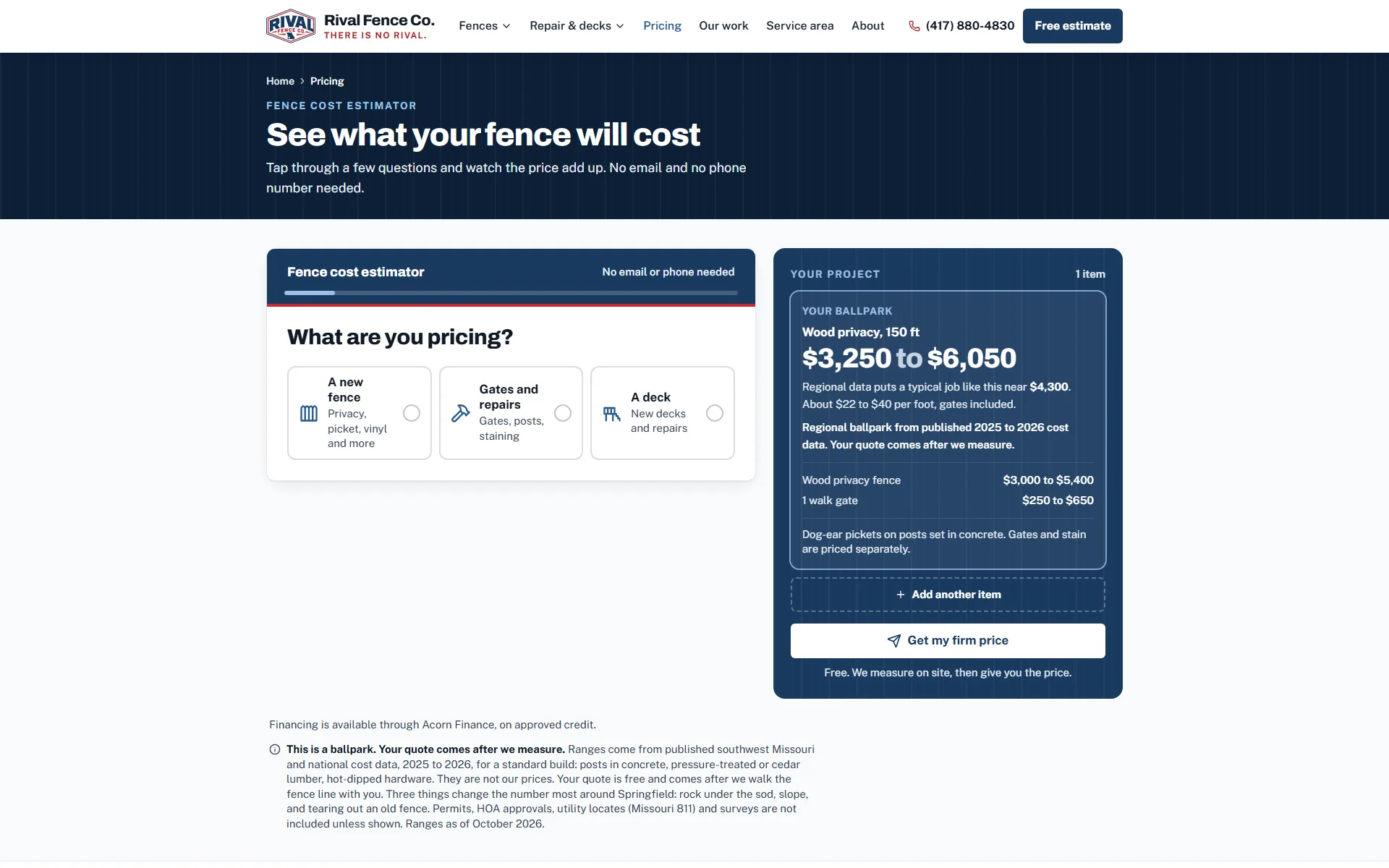
The site's pricing page opens with the offer in one line: see what your fence will cost, tap through a few questions and watch the price add up, no email and no phone number needed. The homeowner picks what they are pricing, a new fence, gates and repairs, or a deck, answers a few taps, and a ballpark appears beside the questions. They can add another item, a gate to the privacy fence, and watch the total change. When they are ready, one button asks for the firm price, and the line under it says what happens: it is free, the crew measures on site, then gives the price.
The ranges are honest about where they come from. The page says they are a regional ballpark from published southwest Missouri and national cost data for a standard build, posts in concrete, treated or cedar lumber, hot-dipped hardware, and that the firm quote comes after the crew measures. It names the three things that change the number most around Springfield, rock under the sod, slope and tearing out an old fence, lists what is excluded unless shown, permits, HOA approvals, utility locates and surveys, and dates the ranges to the month. The fence service pages carry ballpark prices too, so a homeowner reading about shadowbox fence sees what shadowbox fence tends to cost.
Leaving the phone number out of the estimator was the right call for three reasons. A homeowner who gets a number without handing over theirs trusts the company more, and comes back to tap the firm-price button on their own. The number does the qualifying: the homeowner who wanted the lowest possible figure learns where they stand before anyone drives out, and the one who sees the range and keeps going is a real estimate. And the company's word stays good, because the page said what the number was and where it came from. The estimate tools our team builds for other trades follow the same rule.
2. The eleven-question planner
For the homeowner ready to book, the planner is the main door. It opens with one tap, what are we building, a new fence, gates, fence repair, staining and washing, new decks or deck repair, and walks through eleven questions, the ones an estimator needs answered before the visit. It ends with a ballpark and a specialist on the team reaching out to set the free on-site estimate.
Beside the questions, the page tells the homeowner what happens next in three steps: a specialist reaches out by call, text or email to talk through the details; a date is set for the visit, free and with no obligation; the crew walks the yard, measures and prices it, and the homeowner books it only if it works for them. For anyone who would rather talk it through, the phone number, the email address and the hours sit right there.
What reaches the owner is the project described the way an estimator would describe it, down to the timing and any photos the homeowner attached. The visit becomes a measure and a close.
3. The four-question fence finder
Plenty of homeowners do not know shadowbox from picket. The fence finder asks four questions, about privacy, dogs, a pool, upkeep and the HOA, and shows the fences that fit with their ballpark prices. The first question asks what the fence is mainly for: privacy, keeping the dogs in, a safe yard for kids, around a pool, where barrier rules apply, or curb appeal. A homeowner who came in unsure leaves with a fence type, a price range and the estimate button in front of them. For the company, it is the difference between a vague call and a request that already names the fence.
4. Town pages with each town's fence rules
Fence rules change at the city line. Permit thresholds, front-yard rules and fees are set town by town, and a homeowner planning a fence in Nixa wants Nixa's answer. The site has twelve town pages, and each lays out that town's fence rules, with the office to call. The Springfield page cites the city's own administrative rule on which fences need a permit, notes the fee schedule and the new land development code, gives the address and phone number of Building Development Services and links to the city's page. A service-area map with a ZIP code check sits above them all, so a homeowner knows in one tap whether the crew comes to them. How town pages like these are written, and why Google's spam policies reward them and punish name-swapped copies, is in our guide to service area pages that rank.
5. Proof: 191 photos of the company's own work
A fence is the most visible thing a contractor builds, and the gallery holds 191 photos of the company's own jobs. Ten service pages cover the work, from wood privacy fence to gates, decks, repairs and staining, each with the fences to show for it. A homeowner comparing three fence companies on a phone picks the one whose fences they can see. If you build fences, your own finished jobs are the strongest marketing asset you own, and they cost a minute at the truck after each job.
6. What happens when a request comes in
Every request lands in the owner's inbox as a branded email with any photos attached, and a copy goes to EMOR so none slips through. A specialist reaches out and sets the visit. On the builds where our team runs the full follow-up system, that first reply goes out on its own by text and email within seconds and reminders carry the estimate until it is signed. Our lead follow-up page covers how that works, and our guide on how fast a contractor should answer a new lead covers why the first hour matters.
7. Hosting and care
EMOR hosts the Rival Fence site and keeps running it after launch. A fence site in particular needs upkeep: the Springfield page already notes a land development code adopted in 2025 and a zoning map from April 2026, and the price ranges carry a date because material costs move. A site that states rules and ranges has to keep them current, and that is part of the job.
Google Business Profile and reviews
The map results come from your Google Business Profile. Set it up as a service-area business with the towns you build in, keep the name, phone and services identical to the site, post photos of finished fences with the town named, and ask for the review at the final walk-around, when the yard is clean and the fence is new, with the link sent by text that evening. Our guide to getting more Google reviews has the timing and the script.
The spring rush and the rest of the year
Fence season starts the first warm weekend and the phone goes from quiet to full in a week. The estimator and the planner are what let a one-crew company take every one of those requests without losing any to voicemail, because the homeowner gets a number and a next step at 9 PM on a Sunday. The rest of the year runs on the list: gates, repairs, staining and decks for past customers, and a text in late winter to everyone who ran an estimate last year and did not book, offering a date before the calendar fills.
What to measure
- Estimator sessions, planner completions and fence-finder results, and how many became an estimate visit.
- Estimate visits that became signed jobs, and the average footage and size.
- Requests by town, against the twelve town pages.
- Requests by source: Google profile, website, planner, referral, past customers.
- Time from request to first reply, by hour of the day.
- Reviews added this month, and your overall rating.
Where we come in
We build the system a fence company runs on, then host it and keep running it: the site, a cost estimator and planner built around your work, town pages with each town's rules, your Google profile, lead capture that reaches your inbox, and follow-up that carries every estimate until it is signed. Start with our estimate tools page. We build the systems your business runs on. Then we run them with you.
If you run a fence crew of one to five and want the estimate calendar full of jobs worth driving to, answer four quick questions below and we'll tell you straight whether we're a fit.