A homeowner in Madison decides in March that the living room, the hallway and the kitchen cabinets all need paint before the family comes in June. They search for a painter, open three sites, and want the same two things from each: a sense of what the job will cost, and a way to get somebody out to look without a week of phone tag. Painting contractor marketing comes down to being the company that answers both on the first screen, and then walking into a job that is already scoped.
This guide lays out what that takes, using the site our team built for Olmos Painting, a family-owned painting contractor in Madison, Wisconsin. The owner, Oswaldo Olmos, has painted since 2000 and works across Dane County with a small crew. The site launched in October 2026 in English and Spanish. Everything described here is checkable on the live site. The site is new, so there are no results to report yet, and none are claimed.
What is different about selling paint
The estimate is the sale. Nearly every painting job is priced at a walkthrough, so the marketing's whole job is to fill the walkthrough calendar with the right houses.
Prep is the price, and the homeowner cannot see it. Two living rooms the same size can be a day apart in labor depending on the plaster, the trim and what the last painter left behind. A single number on a website would be wrong half the time. A range, with the reasons it moves, is honest and still useful.
Quotes get compared. A homeowner planning a whole-house interior will talk to two or three painters. The one who gave them a range before anyone came out is the one they call back first.
The season is short. In Wisconsin the exterior window runs a few months. Interiors, cabinets and decks are what the rest of the year is made of, and the site has to sell them.
Many markets speak two languages. A homeowner who reads Spanish first should get the same answers and the same way to start.
1. A site that answers the first questions
Ten service pages cover the work by job type, so the homeowner who wants cabinets lands on cabinets. A 17-color deck can be filtered by which way a room faces, because the same gray reads warm in a south-facing room and cold in a north-facing one, and a homeowner who has already picked a color they trust is further along. A pricing page explains the seven things that move a painting price, which gives a homeowner the shape of the cost before they see a number. A 73-photo gallery in seven categories shows the work. Eight long-form guides answer the questions a homeowner types into Google and into ChatGPT, and the site shipped with painter, service, offer and FAQ schema so Google and the AI assistants read what Olmos does without guessing. The badges on the estimate page say what a homeowner wants to know before they let a crew in: insured, EPA Lead-Safe Certified, and Spanish spoken. Those credentials are Olmos's own.
It also has 14 town pages written around each town's housing stock. The Madison page explains that roughly half the city's housing predates 1978 and what that means for lead-safe work, and splits the city by era of construction, because a 1920s plaster house and a 1990s engineered-siding house fail differently and need different prep. Our guide to service area pages that rank covers how those pages are written.
2. The six-step quote builder
This is the piece that changes the kind of job that comes in.
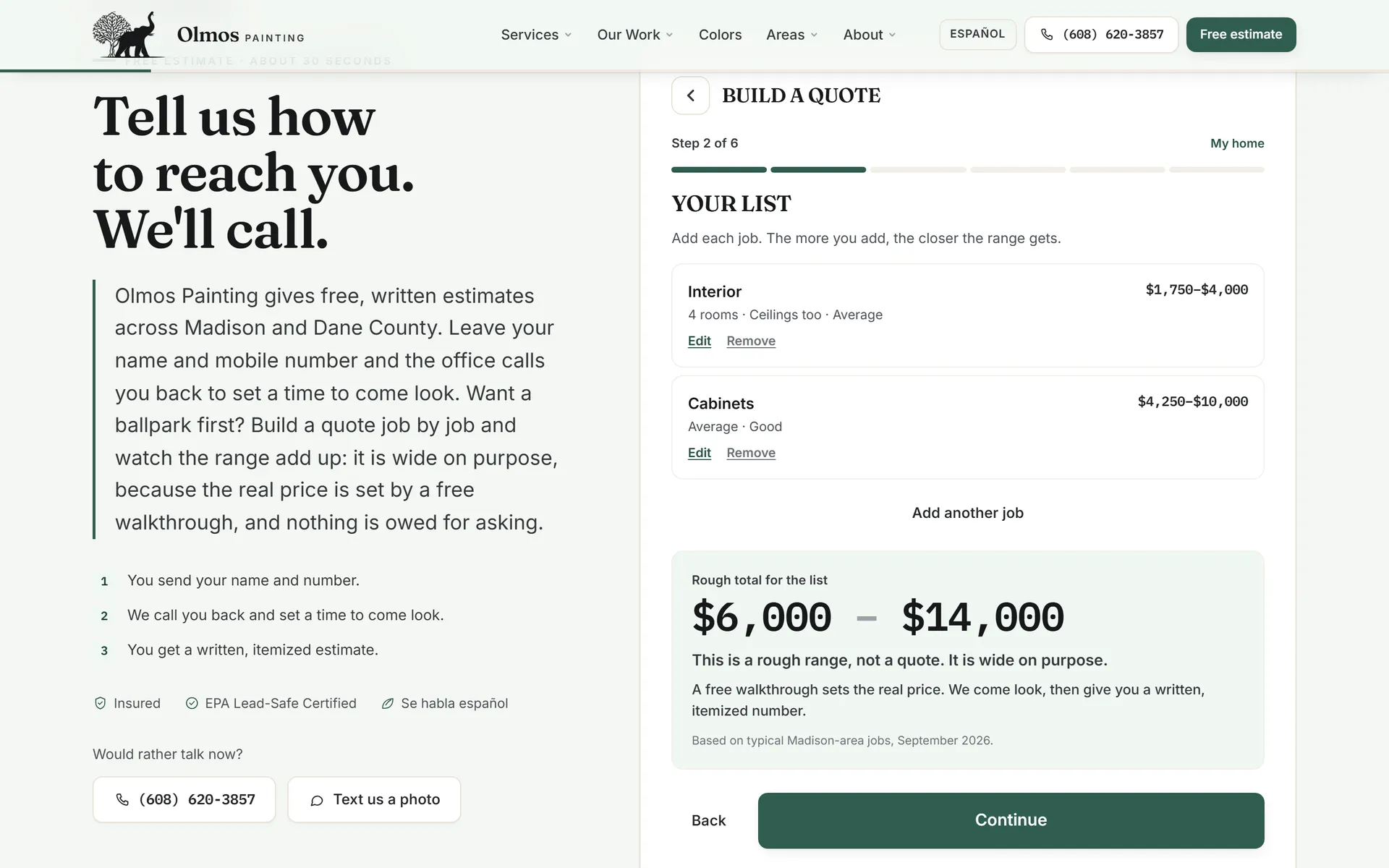
Step one asks whether it is a home or a commercial space. Step two is a job list. The homeowner adds each job, interior rooms, cabinets, a deck, drywall repair, marks the shape it is in, and a rough range for the whole list adds up as they go. The screen says what it is doing: add each job, and the more you add, the closer the range gets. Then timing, optional photos, a name and a mobile number, and send.
The range is wide on purpose, and the page says so. It is built on typical Madison-area jobs, dated to the month, and it tells the homeowner that a free walkthrough sets the real price. A wide, honest range does two things a fixed number cannot. It keeps the company's word good, because the walkthrough will land inside it. And it lets the homeowner see what adding the cabinets does to the total, which is how a one-room inquiry turns into a whole-floor estimate before anyone has driven over.
What reaches the owner is a scoped job: the rooms, the cabinets, the condition the homeowner reported, the timing, the photos and a number to call. The walkthrough starts with the job already understood, and the homeowner who built a list job by job has shown they mean it. The build where our team has run this longest shows the shift: the estimate tool at Samaniego Drywall has scoped over $50,000 in quoted work, and every lead arrives priced instead of anonymous. Our estimate tools page shows how one is built on your pricing.
3. A callback for the homeowner who would rather talk
Beside the quote builder sits a shorter path: leave a name and a mobile number and the office calls back to set a time to come look. The page lays out what happens next in three lines. You send your name and number. We call you back and set a time. You get a written, itemized estimate. For someone who wants to talk right now there is the phone number and a button to text a photo. Every path ends in the same place, a walkthrough on the calendar, and the homeowner picks the path.
4. Spanish, for the whole site
Of the site's 89 pages, 35 are in Spanish: the core pages, the services and the town pages, with an Español toggle at the top of every page. The point is that a homeowner who reads Spanish first gets the whole estimate in Spanish, the same questions, the same range and the same callback, and the site says plainly that Spanish is spoken on the job. Planned at build time, the second language is a matter of writing each page twice with the same facts. Bolted on later, it tends to end up as a translated homepage with nothing behind it. Our website design page covers how our team plans a bilingual build.
5. Google Ads aimed at the jobs you want
Since launch, our team has run Olmos's Google Ads alongside the site. The principles are the same for any painter.
- The click lands on the quote builder or the matching service page. A homeowner who searched for cabinet painting should see cabinets and a way to get a range, never a homepage.
- Ads match the service and the town. The copy names the job and the place the homeowner typed.
- Decide what you will not bid on. The jobs you do not want are the easiest money to save.
- Measure requests and walkthroughs. A paid click is worth what the scoped request behind it is worth.
No results from the Olmos campaign are reported here; the account is weeks old. Our Google Ads page covers how campaigns for trade businesses are set up and tracked to the booked job.
6. SEO, GEO and AEO after launch
With the launch, our team took on the site's SEO, its GEO and AEO for AI answer engines, and the upkeep that keeps all three working: the town pages, the guides, the schema and the Google Business Profile. The job is to make sure that when a homeowner in Dane County asks Google or an AI assistant about a painter, the facts about Olmos are there to be found and specific enough to be cited. How that work runs is on our SEO and GEO page and our GEO and AEO page.
7. The follow-up that carries the estimate
A scoped request is worth most in its first hour. On the builds where our team runs the follow-up system, a request triggers a text and an email from the business within seconds, while the homeowner still has the site open, and reminders carry the written estimate on the dates the owner sets until it is signed or declined. Our guide on how fast a contractor should answer a new lead has the research, and our lead follow-up page has the system. The principle holds whether the reply is automated or the owner's own thumb: the homeowner comparing three painters hears from the one who answered first.
The season, and the list
Exterior season fills itself in a good year. The question is what the site sells the rest of the year. Interiors, cabinets and trim are winter work, and a quote builder that prices them makes them easy to ask for in January. Past customers are the other half: a text in February to last year's exterior customers, offering a date before the spring calendar fills, and a note to everyone who ran a quote and did not book. In the system we build, those go out on their own from the business, on the dates the owner sets.
What to measure
Six numbers, checked monthly:
- Quote builder completions and callback requests, and how many became a walkthrough.
- Walkthroughs that became signed jobs, and the average size.
- Requests by source: Google profile, website, quote builder, ads, referral, past customers.
- Requests in Spanish, so you know what the second language is bringing in.
- Ad spend per scoped request and per signed job.
- Reviews added this month, and your overall rating.
Put the next hour behind the source that brings the jobs you want most. For most owner-run painting companies that is the quote builder and the customer list, because both bring the whole-house jobs with the price already discussed.
Where we come in
We build the system a painting business runs on, then keep running it: the site in one language or two, a quote builder built on your pricing, your Google profile, the ads, and the SEO, GEO and AEO that keep the facts about your company where homeowners and AI assistants look. Start with our estimate tools page. We build the systems your business runs on. Then we run them with you.
If you run a painting crew of one to five and want your next estimates to be bigger ones, answer four quick questions below and we'll tell you straight whether we're a fit.