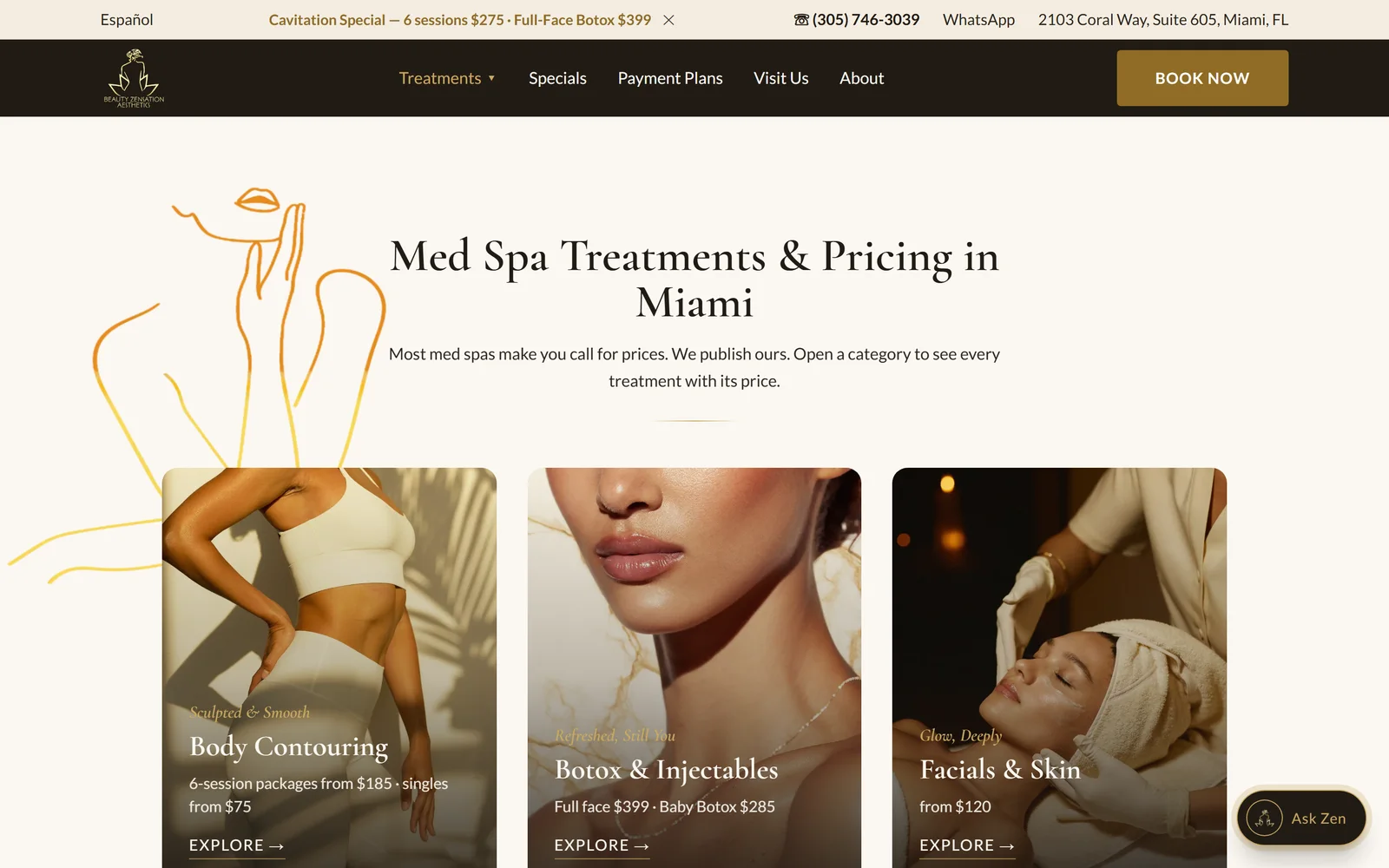
Walk into almost any med spa website and try to find out what Botox costs. You will find a contact form.
The industry standardized on hiding pricing decades ago, for reasons that made sense at the time. Get them on the phone, build rapport, handle the objection. The trouble is that the customer stopped calling to find out, and so did the software they now ask instead.
Beauty Zensation Aesthetics is a family-owned med spa on Coral Way in Miami. When we built their site, we made the opposite bet, and it turned out to drive nearly every other decision in the build.
The bet: publish every price
Every treatment on the site carries its real, published price. Thirty-nine individual treatment pages, each one a real page with a real number on it, organized under six category hubs.
Two things happen when you do that.
The first is human. A shopper comparing three spas for lip filler is doing math in a browser tab, and the one who will not give a number gets closed. Publishing turns your site into the place the comparison ends instead of the place it stalls. It also means the people who do reach out have already accepted the price, which changes the entire character of the conversation the front desk has.
The second is machine. An AI answer engine cannot quote a price it cannot read. When somebody asks Google's AI, ChatGPT, or Claude what a treatment costs in Miami, the businesses that publish are the ones with something citable. Everyone else is invisible in that answer. We wrote about this shift in detail in our piece on becoming the business AI names, and aesthetics is close to a perfect case, because the norm of hiding prices means the field is wide open for whoever stops.
The second bet: a complete Spanish mirror
Miami searches in two languages. A translate widget does not help you there, because there is no separate page for a search engine to index or an assistant to quote.
So the site launched with a true mirror: all 55 pages built in Spanish, each with its own URL, properly linked to its English counterpart. Every treatment page, every category hub, the booking flow, the FAQs. That is not a nice touch for a bilingual market, it is a second full surface of searches you are now eligible to answer.
Zen: five questions to a real number
Most people shopping for aesthetics do not know what they want by name. They know the result they want. They are not searching for a specific injectable, they are thinking "I look tired in photos."
Zen is the AI treatment guide built into the site. It takes a visitor through five questions and returns a recommended starting point with its actual published price, then hands off to online booking, WhatsApp, or a tap-to-call bar pinned to the bottom of every mobile screen.
The important design decision there is the ending. A quiz that finishes on "we will be in touch" is a lead form wearing a costume. Zen finishes on a specific treatment, a specific price, and a specific next step, so the interest converts in the same session instead of turning into a voicemail nobody returns.
The plumbing underneath
The parts nobody sees are what make the rest work:
- Local business schema with geo and opening hours, so Google and the assistants know exactly where the spa is and when it is open.
- A priced offer catalog in structured data, which is the published pricing expressed in the format an answer engine reads directly.
- FAQ markup on the questions customers actually ask.
- A mobile action bar with call, WhatsApp, and book, pinned to every screen, because the overwhelming majority of this traffic is a phone held in one hand.
- Automated follow-up behind every lead, so a quiz completion, a booking, or a WhatsApp message gets a response whether or not the front desk is between appointments.
All of it renders on the server, which means a crawler or an AI engine reads the treatments, the prices, the location, and the hours on the first pass without running any JavaScript. That single technical choice is what separates a site that gets quoted from one that gets skipped.
What we are not claiming yet
The site launched this month. We do not have booking numbers from it, and we are not going to invent any. What is verifiable today is the build itself: 39 priced treatment pages, six hubs, 55 pages mirrored in Spanish, the guide, the booking, the schema, the follow-up. You can see all of it live, and the full breakdown sits on the client story page.
When Cecilia has real numbers to share, we will publish those too, with her name on them. Our other case studies work the same way, including the Little Havana gym that outranked Planet Fitness, where the results came first and the write-up came after.
The transferable lesson
You do not have to be a med spa for this to apply.
If your industry hides its pricing, publishing yours is one of the few remaining moves that is simultaneously better for the customer, better for your search visibility, better for your AI visibility, and better for your front desk. The reason more businesses do not do it is habit, not strategy.
If your market speaks two languages, build for both properly.
And if your site ends every path with a form, replace at least one of those endings with a real answer and a real next step.
We build, host, and run sites like this one, including the SEO and the follow-up behind it. If you want to know what that would look like for your business, book a call. Before it, we review your current site and your Google Business Profile, and the call opens with what we would build. More on how we approach these builds is on our website and apps page, and the marketing side for this category is covered in our guide to social media for med spas.